Unplanned downtime and hazardous leaks in a refinery are never just operational inconveniences. They represent catastrophic financial losses and severe safety risks. When volatile hydrocarbons escape containment, the stakes instantly become life-or-death. Refineries must operate under extremely hostile conditions.
Transitioning from basic fluid handling to extreme-condition processing changes everything. Standard industrial equipment simply fails under intense pressure, extreme heat, and harsh corrosive environments. Refineries need highly specialized, purpose-built machinery to survive these brutal daily conditions.
While API 610 pumps demand a heavier upfront capital requirement, their rigorous engineering standards are absolutely non-negotiable. Now in their 12th Edition, these manufacturing mandates ensure absolute reliability, mitigate thermal expansion, and maintain stringent compliance in modern petrochemical processing. You will learn how these structural advantages dictate configuration choices, shape maintenance routines, and guide smart procurement strategies.
Risk Mitigation Over Initial Cost: API 610 pumps eliminate the systemic vulnerabilities of standard ANSI pumps, providing superior MTBF (Mean Time Between Failures) in high-pressure, high-temperature environments.
Purpose-Built Configurations: From OH2 process pumps for versatile, high-temp applications to BB1 double suction pumps for massive flow rates, API 610 dictates highly specific geometries for distinct refinery nodes.
Stringent Modern Compliance: Adherence to the latest API 610 12th edition mandates stricter performance testing (9 points) and mandatory bearing temperature monitoring.
Smart Procurement: Understanding the true cost drivers (like API 682 seals and exhaustive documentation) allows engineers to specify the exact pump required without unnecessary over-engineering.
Standard industrial pumps inevitably reach an operational breaking point. We clearly define this threshold when process temperatures exceed 300°F (150°C). Extreme fluid volatility, suspended solids, and high specific gravity destroy basic seals and standard cast-iron casings. Off-the-shelf equipment lacks the structural rigidity needed to handle the intense nozzle loads generated by expanding high-temperature piping.
Operating a hazardous fluid transfer pump comes with a strict compliance and safety mandate. Regulatory bodies enforce uncompromising directives. OSHA, EPA, and ATEX standards require fail-safe fluid containment. API 610 standards, equivalent to ISO 13709 internationally, provide the definitive defensive framework. They protect facilities against severe environmental fines, catastrophic fires, and tragic safety incidents.
Engineers often face questions regarding the 40–60% capital expenditure (CapEx) premium attached to API compliant pumps. We must contrast this initial price tag directly with the extreme cost of unplanned downtime. A single hour of halted refinery production costs exponentially more than the premium paid for upgraded machinery. Furthermore, localized fires caused by standard seal failures create devastating financial liabilities. Investing heavy capital upfront directly neutralizes these massive operational threats.
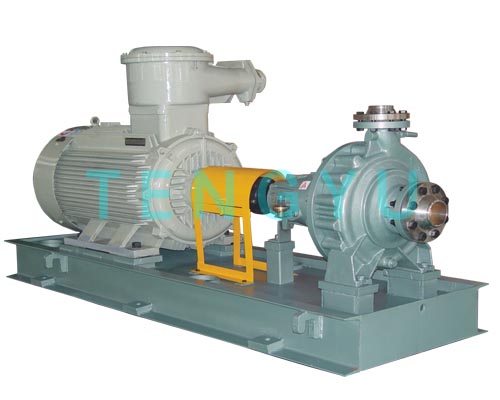
A true petrochemical centrifugal pump utilizes unique engineering geometry. These design choices directly combat the harsh physics of oil refining.
API 610 casing designs actively manage severe thermal expansion. Standard pumps use foot-mounted designs. When exposed to high heat, foot-mounted casings expand upward, pushing the pump shaft out of alignment. Center-line support mounting places the casing supports directly on the horizontal axis of the shaft. As the metal heats and expands, it expands equally above and below the center-line. This design preserves precise shaft alignment and protects delicate mechanical seals from shattering.
Extreme internal pressures demand heavy-duty construction. The structural rigidity of these units prevents catastrophic deformation.
Double-Volute Casings: These designs actively balance radial thrust loads acting on the impeller. This prevents shaft deflection during operation.
Continuous Seal-Welded Baseplates: API specifications mandate solid, continuous welds rather than skip welds. They feature built-in sloped drainage systems to catch toxic leaks safely.
Strict Nozzle Load Capacities: The heavy casings absorb massive external piping forces without transferring stress to the internal rotating components.
Best Practice: Always verify baseplate weld integrity during site commissioning. Even microscopic gaps trap corrosive liquids, eventually degrading the foundation.
Reliability hinges on bearing health. API 610 enforces highly robust bearing requirements. The standards mandate a minimum 25,000-hour continuous operation lifecycle. Lubrication protocols remain exceptionally strict. Facilities must install minimum 4-ounce constant-level oilers. These oilers maintain perfect lubrication levels automatically. Strict vibration limits ensure the rotating assembly runs flawlessly, preventing premature bearing fatigue.
Refineries utilize distinct configurations for specific operational nodes. We categorize them primarily into Overhung, Between-Bearings, and Vertically Suspended types.
The OH category serves as the primary workhorse for standard refinery routing. They handle distillation reflux, light hydrocarbon transfer, and typical heat exchanger duties.
Evaluation Note: The standout feature is its back-pull-out design. Maintenance teams can easily remove the bearing housing, shaft, and impeller without disturbing the heavy casing or disconnecting the high-pressure piping.
These massive units handle heavy-duty pipeline boosting, critical charge pumps, and ultra-high-pressure fluid transfer. Supporting the shaft on both ends drastically reduces deflection.
Evaluation Note: We contrast the axially split BB1 against the radially split BB5. The BB1 allows easier internal maintenance access simply by lifting the top casing half. The double-casing BB5 barrel pump remains essential for extreme pressure scenarios where minimizing leakage risk is paramount.
Engineers deploy VS configurations in hydrocarbon drain pits and limited-footprint areas. They function brilliantly as booster applications requiring a suction can, specifically the VS6 model. They excel where NPSH (Net Positive Suction Head) available is critically low.
To clarify these selections, consider this summary configuration chart:
API Category | Primary Type | Key Refinery Application | Distinct Engineering Advantage |
|---|---|---|---|
Overhung (OH) | OH2 | Reflux, Heat Transfer, Light Routing | Back-pull-out design for rapid maintenance |
Between-Bearings (BB) | BB1 / BB5 | Heavy Charge, High-Pressure Boosting | Minimal shaft deflection; double-casing safety |
Vertically Suspended (VS) | VS6 | Drain Pits, Low NPSH Scenarios | Space-saving vertical orientation; enclosed suction can |
Budgeting for these units requires nuance. You must understand exactly where costs originate and where optimization is safely possible.
The API 610 standard does not cover seal selection directly. It leaves shaft sealing protocols entirely to the API 682 standard. Choosing the right seal arrangement dramatically impacts the final cost.
Arrangement 1: Single seal configuration. Cost-effective but limited to lower-risk fluids.
Arrangement 2 & 3: Dual seal configurations. They require complex support systems (like Plan 53B or Plan 54). They safely contain lethal gases but significantly inflate upfront costs.
Rigorous testing drives up manufacturing costs. The updated 12th edition now strictly requires up to 9 mandatory performance test points across the operating curve. Previous editions required fewer points. You must also evaluate non-destructive testing (NDT) needs. Standard hydrostatic testing suffices for many basic applications. However, exhaustive dye penetrant or radiographic testing on casings becomes strictly necessary for handling lethal hydrogen sulfide.
Metallurgy dictates pricing. Manufacturers offer standard carbon steel, robust duplex stainless steel, or exotic high-nickel alloys. Engineers often over-specify casing materials out of caution.
Common Mistake: Demanding super-duplex stainless steel for benign, non-corrosive lubricating oils. Only specify expensive alloy upgrades if the chemical composition and process temperature objectively warrant the metallurgical defense.
When approaching vendors, refinery managers must provide highly structured requirements. Hazy specifications lead to dangerous equipment mismatches.
Define Fluid and Thermal Profiles Precisely: Never base your Request for Quotation (RFQ) strictly on nominal operating points. You must specify the absolute worst-case scenario. Document maximum fluid viscosity, peak corrosivity levels, and extreme thermal spikes.
Assess Vendor Engineering & Testing Capabilities: Evaluate the manufacturer's facility directly. Ensure they operate a hydraulic test loop capable of full ISO 9906 or HI 14.6 compliance. You should demand total transparency. Look for vendors who willingly share unedited performance curves and raw vibration test data.
Evaluate Supply Chain and Lead Times: Custom engineering requires patience. Sourcing specialty alloys and fabricating custom continuous-weld baseplates takes months. Factor significantly longer lead times into your project timeline. Prioritize vendors offering robust post-installation commissioning and strong local predictive-maintenance support.
Use the following vendor evaluation summary chart during your procurement phase:
Evaluation Category | Mandatory Requirement | Red Flag / Warning Sign |
|---|---|---|
Performance Testing | Full 9-point test curve (12th Edition) | Refusal to share raw vibration/NPSH data |
Material Sourcing | Certified material test reports (CMTRs) | Vague alloy sourcing or undocumented foundries |
Post-Sale Support | Local commissioning and maintenance tech | No regional presence for emergency parts |
An API compliant refinery process pump is not merely a fluid mover. It operates as a critical safety and reliability asset built explicitly to withstand worst-case process scenarios. Standard equipment will eventually buckle under extreme temperatures and volatile pressures, leading to disastrous consequences.
You must prioritize operational safety and long-term mechanical stability over initial capital savings. Adhering to the latest 12th edition guidelines guarantees robust bearing life, secure shaft alignment, and fail-safe casing integrity. Understand your precise fluid dynamics to prevent unnecessary material over-engineering while securing the perfect seal arrangements.
Your immediate next step should be auditing your current heavy-duty fluid transfer nodes. Identify aging standard equipment operating near its thermal limits. Consult with an experienced application engineer to draft precise API data sheets before moving into your next procurement phase.
A: ANSI pumps are built to dimensional standards for general chemical processing at lower pressures and temperatures. API 610 pumps focus entirely on reliability and safety. They utilize much heavier casings, center-line mounting, and extremely robust bearings specifically designed for the extreme pressures, temperatures, and harsh volatility of the oil and gas industry.
A: Key updates include a mandatory 9-point performance testing requirement (increased from 6 points). The new edition also mandates stringent bearing metal temperature monitoring. Furthermore, it introduces API RP 691 guidelines for establishing risk-based machinery management and predictive maintenance protocols.
A: Not necessarily. For lower-risk, low-temperature utilities strictly within a safe refinery perimeter, modified pumps or highly robust ANSI models may suffice. However, for continuous-duty hydrocarbon processes and lethal fluids, strict API 610 compliance is heavily recommended to pass stringent safety, environmental, and insurance audits.
A: Lead times stretch due to extensive custom engineering. Manufacturers must source highly specific alloy castings like duplex or super duplex stainless steel. Additionally, complex continuous-weld baseplate fabrication and exhaustive, mandatory performance testing across multiple operational points consume significant time before shipment approval.