For plant managers and process engineers, the central bottleneck in wet-process phosphoric acid (WPA) production often hides in plain sight. Filtration efficiency directly depends on the reaction-stage agitation inside your digestion tanks.
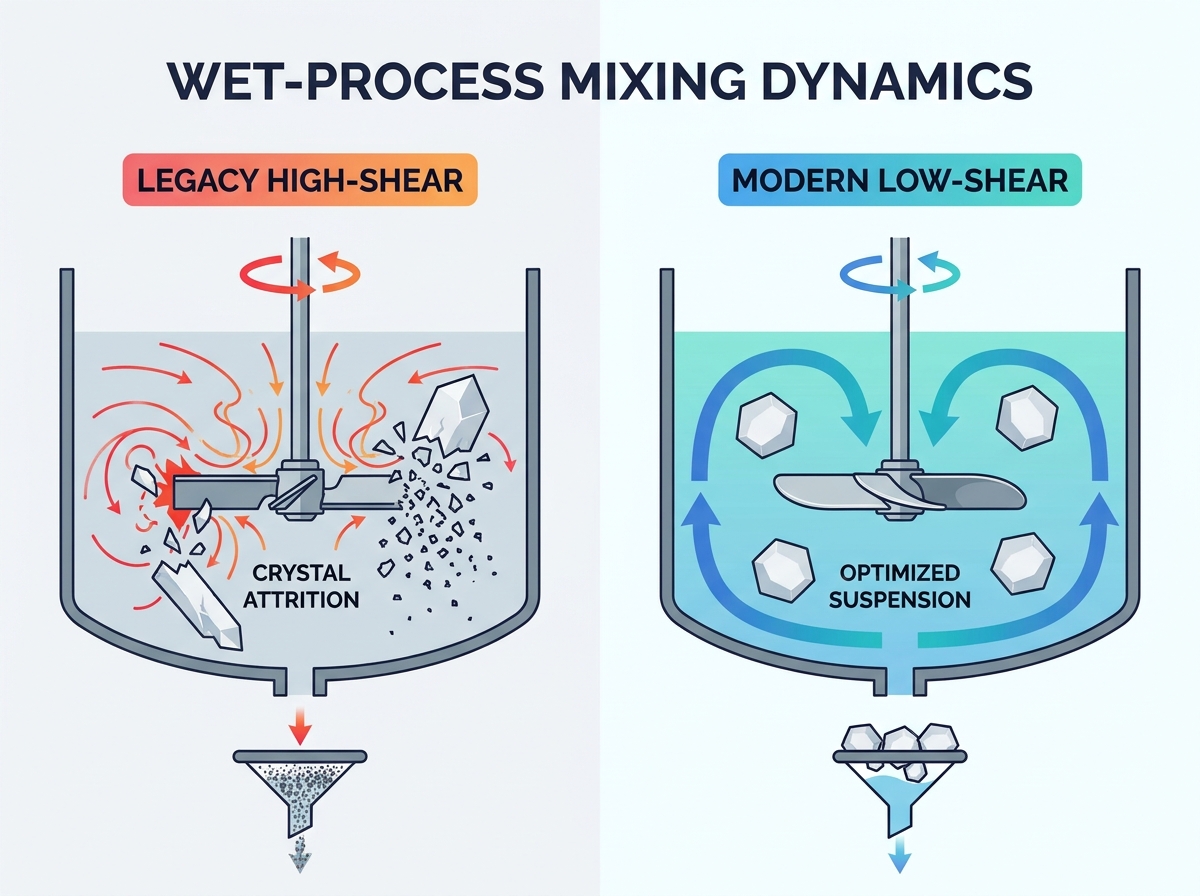
Operators face a fundamental conflict when managing these slurry dynamics. Insufficient mixing leads to rapid gypsum settling and localized tank scaling. Conversely, aggressive mixing shatters fragile gypsum crystals and clogs downstream filters.
An effective wet process acid agitator must move beyond brute-force horsepower. In this article, you will learn how optimized hydrodynamics suspend dense slurries while preserving crystal integrity. We will explore modern impeller technologies, evaluation dimensions, and practical steps to maximize your overall plant throughput.
Plant throughput is limited by filtration rates, which are largely dictated by the particle size distribution of gypsum crystals formed and maintained during the mixing phase.
In phosphoric acid mixing, gypsum attrition is the primary hidden cost of relying on outdated, high-shear radial agitation systems.
Upgrading to hydrofoil-based impeller designs enables low shear gypsum suspension, balancing necessary fluid velocity with crystal preservation.
Evaluating a mixing solution requires scrutinizing both Computational Fluid Dynamics (CFD) models for hydrodynamics and metallurgical specifications for abrasive/corrosive reliability.
You must define the economic stakes clearly before evaluating any equipment. Plant profitability hinges directly on acid recovery rates and operational uptime. The filtration rate serves as the ultimate indicator of mixing success. When reactors produce uniform, large crystals, pan and belt filters operate at maximum design capacity. Faster filtration means higher daily production volumes. It also allows for more efficient washing cycles to maximize acid recovery.
High-shear mixing triggers a cascading failure across the plant. When impellers spin too fast, they shatter fragile gypsum crystals into fine particles. These fine particles immediately blind the filter cloths on your separation equipment. Once blinding occurs, filter wash times increase dramatically. Slower washing means less phosphoric acid separates from the gypsum cake. This inefficiency directly reduces your daily P2O5 yield. Your plant loses valuable product simply because the agitation was too aggressive.
You must balance attrition concerns against the severe risks of under-mixing. Failing to maintain off-bottom suspension creates distinct operational nightmares. Heavy gypsum solids settle rapidly at the tank bottom. This settling causes tank silting and reduces your active reactor volume. Localized supersaturation then triggers severe scaling on tank walls and internal components. Furthermore, unreacted phosphate rock gets trapped in the sludge bed. You lose extraction efficiency and eventually face forced shutdowns for manual mechanical clean-outs.
Process engineers know the realities of chemical manufacturing. No single agitator can magically solve problems caused by poor phosphate rock quality. High impurity levels will always challenge your process. However, mixing energy optimization acts as your most reliable controllable variable. You operate in a highly variable chemical environment. By controlling the fluid dynamics, you stabilize the crystallization environment. This stability allows you to manage rock variability much more effectively.
The industry is shifting away from outdated mixing philosophies. Traditional radial-flow impellers, such as flat blade turbines, rely heavily on high shear to distribute solids. They blast fluid outward against the tank walls. Modern axial-flow hydrofoil impellers focus entirely on fluid motion. They push large volumes of slurry downward. This modern approach mirrors the aerodynamic principles used in aircraft wings, ensuring maximum flow with minimal turbulence.
Table 1: Comparing Agitator Impeller Types in WPA Production
Impeller Characteristic | Legacy Radial-Flow (Flat Blade) | Modern Axial-Flow (Hydrofoil) |
|---|---|---|
Primary Fluid Direction | Outward toward tank walls | Downward toward tank bottom |
Shear Generation | High localized shear | Low uniform shear |
Suspension Efficiency | Low (requires higher RPM) | High (moves large volumes efficiently) |
Crystal Preservation | Poor (high attrition risk) | Excellent (promotes crystal growth) |
Understanding the physics reveals why newer designs succeed. High volumetric pumping achieves off-bottom suspension far more effectively than shear. Axial flow designs sweep the tank bottom continuously. They require significantly lower rotational speeds compared to shear-dependent designs. By moving massive amounts of fluid gently, they keep heavy gypsum particles suspended. This prevents the silting problems associated with low-flow radial mixers.
When aiming to control phosphoric acid mixing gypsum attrition must be managed proactively. You achieve this by minimizing the impeller tip speed. Engineers also optimize the blade profile to reduce localized zones of extreme shear. Smooth hydrofoil blades slip through the dense slurry rather than tearing it apart. This careful hydrodynamic design protects the fragile edges of growing gypsum crystals from mechanical destruction.
We must acknowledge the practical requirements of modern mixing technology. Low-shear designs are undeniably superior for crystal growth. However, they demand precise tank baffling to function correctly. Without proper baffling, the entire fluid mass simply swirls in a vortex without actually mixing. Strategic baffle placement prevents dead zones in large-scale continuous reactors. It converts rotational energy into the vertical flow needed for proper suspension.
You must evaluate vendor specifications carefully for flow-to-power ratios. The best practice is to demand the calculated pumping number (Nq) from the manufacturer. High-efficiency impellers should deliver the required off-bottom suspension velocity using less motor power. This efficiency reduces your long-term electricity consumption. It also allows you to allocate electrical capacity elsewhere in the plant.
Assess tip speeds thoroughly during the procurement phase. Shortlist vendors who provide empirical data supporting their designs. Pilot-scale evidence must demonstrate targeted particle size distribution (PSD) preservation. Achieving low shear gypsum suspension ensures the crystals grow large and uniform. You should request case studies showing filter feed improvements after installing their specific agitator models.
WPA slurries are famously difficult to handle. The slurry is dense, with a specific gravity often exceeding 1.5. You must evaluate the agitator shaft design for resistance to fluid forces and bending moments. Furthermore, assess the ability to start up in a settled bed. Power outages happen. High start-up torque capabilities are essential to restart the mixer when solids have dropped to the bottom.
Critical Shaft Speed: Ensure the operating speed remains safely below the shaft's first natural frequency to prevent vibration.
Gearbox Service Factor: Mandate a high service factor to handle the dynamic shock loads of dense slurry mixing.
Impeller Hub Design: Check for robust hub connections that will not shear under heavy starting loads.
Process environments in WPA plants are incredibly harsh. Hot sulfuric and phosphoric acid mixes contain highly abrasive silica and unreacted rock. You must assess metallurgy options meticulously. Standard stainless steel will fail rapidly. Evaluate materials like Ferralium 255 or Alloy 28. In many cases, specialized rubber or elastomer linings offer the best protection. Compare these material choices against your anticipated lifespan and maintenance cycles.
Never buy an agitator off the shelf for this application. You must require vendors to provide specific CFD (Computational Fluid Dynamics) modeling. This modeling must account for your unique tank geometry, baffle configuration, and slurry rheology. CFD visualizes the velocity profile inside the tank. It highlights potential dead zones before you fabricate any steel. This step is non-negotiable for a successful installation.
Retrofitting an existing concrete or alloy reactor presents unique challenges. You face strict structural constraints. Modern axial impellers often utilize larger, heavier, low-speed gearboxes to deliver high torque. You must highlight these structural considerations early. Your engineering team might need to reinforce the tank roof or mounting bridges to support the heavier equipment safely.
A common mistake is relying purely on lab-scale crystallization tests. While these small tests are useful for basic chemistry, scaling up hydrodynamics is highly non-linear. Pilot tests often underestimate the industrial shear forces applied by large impeller blades. Look for vendors with verifiable case studies. They need proven field experience in similar continuous industrial WPA plants, not just laboratory credentials.
Define accurate slurry rheology parameters, including viscosity and specific gravity.
Execute site-specific CFD modeling for the exact tank geometry.
Analyze the model for dead zones and verify off-bottom velocity.
Confirm the structural requirements for mounting larger gearboxes.
Selecting the right partner requires asking difficult questions. Use this checklist to audit potential equipment vendors:
Do they lead with process guarantees? Look for promised filtration rate improvements, not just basic mechanical specifications.
Can they demonstrate relevant expertise? They must understand the distinct differences between the dihydrate and hemihydrate processes used in your facility.
Do they provide references from other phosphoric acid producers utilizing similar rock grades?
Are their gearboxes and mechanical seals specifically rated for aggressive chemical environments?
You need a benchmark before you begin. Conduct a baseline audit immediately. Document your current filter feed particle size distribution using laser diffraction. Measure your existing agitator power consumption. Track your current filtration rates over a typical month. Complete this audit before engaging vendors for a retrofit proposal. This data allows you to prove the exact return on investment once the new equipment runs.
Agitation in wet-process phosphoric acid is a precision operation. It is not a brute-force necessity. Throwing more horsepower at a tank usually destroys crystal structure and degrades plant performance. You must prioritize smart hydrodynamic design over sheer power.
Protecting the gypsum crystal structure directly translates to faster filtration. It ensures higher acid recovery and lowers overall energy consumption. Upgrading to optimized impeller systems removes a massive bottleneck from your daily production targets.
Encourage your process engineers to challenge equipment providers. Demand data-backed, site-specific mixing models. By insisting on rigorous validation, you ensure your next agitator investment drives measurable throughput improvements across the entire facility.
A: Broken or fine gypsum crystals clog filtration equipment, slowing down the separation of phosphoric acid and reducing the entire plant's production capacity.
A: It relies on high-efficiency hydrofoil blades that generate massive axial fluid flow to suspend solids, keeping tip speeds low to prevent mechanical damage to fragile crystals.
A: Yes, optimizing the flow pattern eliminates the dead zones where localized supersaturation and scale formation occur, though it must be balanced carefully to avoid increasing crystal attrition.
A: Highly recommended. Because WPA reactors have complex internal geometries and extreme fluid properties, CFD minimizes the risk of costly post-installation modifications.